

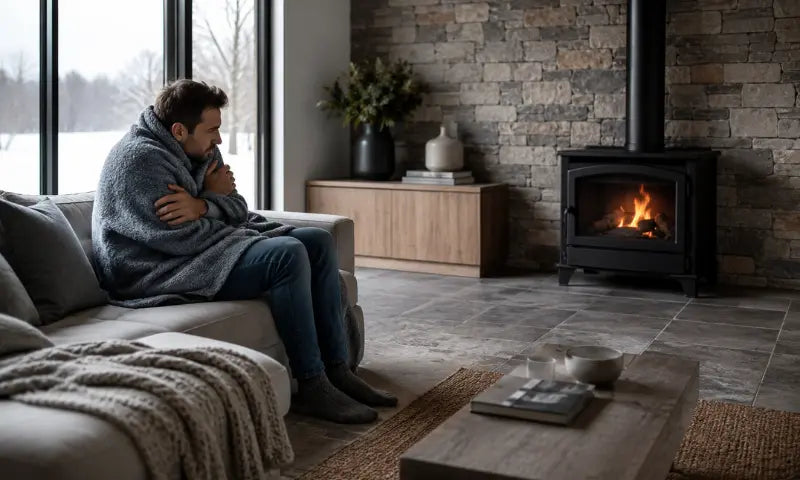
Here's a myth worth busting straight away: stone doesn't generate cold. It can't. Stone is just a material, it has no more ability to "make" a room cold than timber, tile or carpet does. And yet it gets blamed every winter, while the actual culprits get away scot-free.
So, if it's not the floor material itself, what is it? You've had the heater running for an hour. The air feels fine. And yet the second your feet hit the ground or your hand brushes a bare wall near the window, it's like stepping into a different season entirely. If that sounds familiar, you're not imagining it, and it's not your flooring's fault. There are two real culprits here and most winter advice only ever talks about one of them.
Here's the bit most winter advice skips over: heat rises. So a heater can make the air in a room feel perfectly warm while the floor, the surface you're actually in contact with, all day, every day stays stubbornly cold underneath you. And it's not just floors. Bare, uninsulated walls quietly do the same thing, radiating cold back into a room long after the heater's earned its keep. It's one of the most common (and most misunderstood) winter comfort problems in Australian homes and by the end of this, you'll know exactly why it happens and what actually fixes it.
Why Australian Homes Struggle With This More Than You'd Expect?
A lot of Australia's housing stock, especially older homes, was originally built with our long, hot summers in mind rather than winter - think verandahs, single-brick walls and airflow-focused design, none of which do much for you in July. Add in swinging daily temperatures (the classic "four seasons in one day"), and you get homes where the air can be heated easily enough but the floors and walls take far longer to catch up, if they ever really do.
The result is a very familiar Australian winter experience: a lounge room that feels warm from the couch but has ice-cold tiles by the back door, or a bathroom where the heater's been on but the floor still gives you a shock every morning. Solving that isn't really about turning the heater up higher, it's about addressing the actual surfaces you're standing on.
The Fix Most People Overlook: Heating the Floor Itself
This is where underfloor heating earns its reputation as one of the more genuinely effective winter upgrades for Australian homes, rather than just a "nice to have." Instead of heating the air and hoping it eventually warms the floor too, underfloor heating warms the floor surface directly which means the room heats more evenly, there are no cold spots near doorways or tiled areas, and you're not relying on hot air rising past you before it does anything useful.
There are two main systems worth knowing about:
- Electric underfloor heating - thin heating elements installed under the floor surface. It's generally the more practical option for smaller, targeted spaces like a bathroom, ensuite, or kitchen, and tends to suit renovations where you don't want to majorly disrupt the rest of the home.
- Hydronic underfloor heating - warm water circulated through pipes beneath the floor, generally recommended for larger areas and whole-home heating. It's usually the better fit if you're planning it in from the start of a new build or a major renovation, since the pipework goes in before the slab is poured.
Do You Know? This Isn't a New Idea
Underfloor heating actually dates back roughly 2,000 years. The Romans built systems called hypocausts, where hot air from a furnace circulated beneath raised stone floors, warming entire rooms from the ground up. It's genuinely one of the oldest heating tricks in the book; we've just gotten a lot better at the engineering since.
But Doesn't Stone Floor Just Stay Cold?
As promised at the start - NO and here's the actual mechanism behind it.
- Stone simply reflects the temperature of the room and surfaces around it, the same as any other flooring material would in an unheated space. The difference is what happens once heating is introduced.
- Dense natural stones like travertine, limestone and marble have excellent thermal conductivity, meaning they absorb warmth from underfloor heating efficiently and release it steadily back into the room.
- Carpet, by comparison, actually works against underfloor heating, the same insulating quality that makes it feel soft and warm on its own also traps heat before it reaches the room properly.
- Not every stone behaves identically, either. Denser stones like marble and granite warm through faster once the system's running, while thicker slabs of any stone take a little longer to heat but hold that warmth for longer once they're there.
Either way, the practical takeaway is the same: stone isn't the problem. It's actually one of the best-suited materials for solving it, provided it's paired with the right heating underneath.
The Other Cold Spot Nobody Talks About: Walls
Floors get most of the attention but bare walls and unused fireplaces are another quiet source of that "still feels cold" sensation in a lot of Australian living rooms. This is where interior stone cladding earns its place, a stacked stone or split-face feature wall around a fireplace absorbs radiant heat while the fire's going, then keeps releasing gentle warmth into the room well after the flames have died down.
There's a genuine psychological element here too. Natural materials like stone and timber consistently read as warmer and more comforting than flat, painted surfaces, which is part of why bringing natural texture indoors (an approach often called biophilic design) has become such a mainstay of good interior design. A stone-clad feature wall doesn't just retain physical warmth, it visually signals warmth, which matters more than people expect on a grey winter day.
Putting It All Together: A Practical Winter Comfort Checklist
If your home has that "warm air, cold floor" problem, here's the order worth thinking about it in:
- Start with the floor. If you're renovating or building, plan underfloor heating in from the start; electric for smaller, targeted rooms, hydronic for larger living areas or whole-home heating.
- Choose flooring that works with it, not against it. Natural stone flooring is one of the best-performing partners for underfloor heating precisely because of its thermal mass, it's a genuinely practical choice, not just an aesthetic one.
- Address cold walls, not just cold floors. A stone-clad feature wall or fireplace surround adds real radiant warmth to a room, not just visual interest.
- Layer with rugs and warm lighting. A well-placed rug over heated stone flooring adds texture without undoing any of the thermal benefit, and warm, low lighting makes textured surfaces like stone cladding genuinely glow rather than look flat.
- Talk to a licensed installer early. Underfloor heating, in particular, involves electrical or plumbing work and changes to floor height, so it's worth having that conversation as early in a renovation or build as possible rather than as an afterthought.
The Actual Secret
The reason so many Australian homes still feel cold despite the heater running isn't a lack of effort, it's that most of the standard advice (more cushions, more candles, more throws) treats the symptoms rather than the cause. Solve the floor and wall problem properly, with the right heating and the right materials and the cushions and candles finally get to do what they're meant to: add the final, cosy layer on top of a home that's already doing the hard work of staying warm.
If you're planning ahead, Stone Centre's range of natural stone flooring and interior stone cladding is worth exploring. Grab a free sample and get a feel for the material before you commit to a layout or a heating system.
FAQ’s
Q.1 Does natural stone flooring stay cold in winter?
Ans. No, stone doesn't generate cold, it simply takes on the temperature of the room and surfaces around it, the same as any hard flooring material would. When paired with underfloor heating, natural stone actually performs better than most alternatives, including carpet because it absorbs and holds warmth rather than insulating against it.
Q.2 Is underfloor heating worth it for natural stone floors in Australia?
Ans. Yes, particularly because stone's thermal mass means it warms evenly and continues releasing heat well after the system switches off. Electric systems suit smaller spaces like bathrooms or renovations; hydronic systems suit larger living areas or whole-home heating and are best planned in from the start of a new build.
Q.3 Can interior stone cladding actually make a room warmer or is it just decorative?
Ans. It's genuinely functional, not just decorative. A stone-clad feature wall or fireplace surround adds real thermal mass to a room, absorbing radiant heat and releasing it gradually which is exactly why bare, uninsulated walls are often just as responsible for a "still feels cold" room as an unheated floor.