

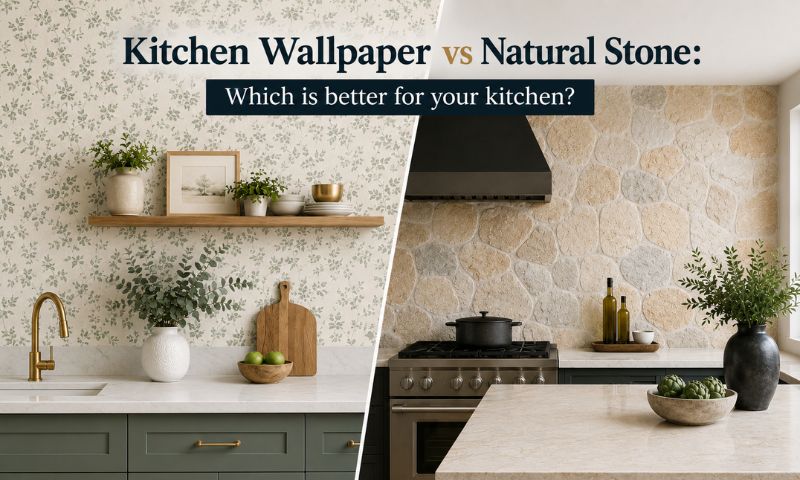
Ask anyone with wallpaper in their kitchen on how it's holding up and you'll usually get a pause before the answer. That pause says a lot. Maybe it's peeling near the stove. Maybe there's a faint grease patch that no amount of scrubbing will shift. Compare that to someone with a natural stone kitchen wall. Ask them the same question and they barely think twice. It still looks like the way it did on day one. That difference, between hesitation and confidence, is really what this whole decision comes down to.
Your kitchen wall isn't just decoration. It's a surface that deals with heat, steam, oil splatters and daily wear, day after day, year after year. So, it's worth understanding what you're actually choosing between before you commit.
The Quick Reality Check on Wallpaper
Wallpaper isn't one single product and it comes with genuine trade-offs in a kitchen setting. Let’s talk about popular and widely used materials.
- Vinyl and non-woven types are marketed as wipeable, but they struggle with sustained heat and steam near cooktops.
- Peel-and-stick options are easy (generally for rental or a quick refresh), but the adhesive tends to loosen in humid, heat-prone zones over time.
- Textured finishes look lovely in photos, but the extra surface area makes grease and dust harder to clean off.
Most complaints about the wallpaper say that they are peeling corners near heat, faint yellowing from steam, grease that won't fully lift and seams that show up as the material shifts with humidity. Wallpaper is not a bad product. It's just not built for what a kitchen puts it through.
That's exactly where a solid yet stylish material like natural stone comes in the design picture.
Quick Comparison: Kitchen Wallpaper vs Natural Stone
| Feature | Kitchen Wallpaper | Natural Stone |
|---|---|---|
| Heat resistance | Warps, discolours or peels near stovetops | Handles direct heat without damage |
| Moisture & steam | Absorbs moisture, leading to bubbling or mould | Naturally moisture-resistant when sealed |
| Grease & stains | Grease sinks into seams and texture | Wipes clean, especially with a honed or polished finish |
| Lifespan | Typically, 3-5 years in a kitchen or less | Lasts long time with right care |
| Look & texture | Printed pattern, repeats across the roll | Natural veining, every piece is unique |
| Feel | Flat, papery surface | Solid, tactile, cool to the touch |
| Maintenance | Needs gentle products and careful handling | Wipe-down cleaning, occasional resealing |
| Upfront cost | Lower | Higher |
| Long-term value | Repeated replacement costs add up | One installation, rest depends on maintenance and care |
Getting to Know Natural Stone a Little Better
Not all natural stones are the same and picking the right type makes a real difference to how your kitchen performs and feels.
- Sandstone: A standout choice for Aussie kitchens. It brings warm, sandy tones with soft natural streaking and it handles heat well without radiating it back into the room. It also pairs beautifully with timber cabinetry, a popular combo in local Aussie homes right now.
- Limestone: Softer and more muted in tone, limestone gives a calm, understated backdrop. It's a strong option if you want your splash back or feature wall to sit quietly behind bold cabinetry or a statement island.
- Travertine: Known for its subtle pitted texture and warm beige-to-ivory tones, it adds a slightly rustic, Mediterranean feel. Also, it’s a favourite for kitchens going for a relaxed, sun-washed aesthetic.
- Granite: Denser and harder wearing than most other stone types. It's an excellent pick for kitchens tiles and walls that see heavy daily cooking, since it hides scratches and dirt.
- Marble: Elegant and instantly recognisable, with dramatic veining. It does need a little more care around acidic spills but as a feature wall away from direct splash zones, it's hard to beat for sheer visual impact. you can also use this stone as kitchen tiles for a luxe feel.
What Natural Stone Solves that Wallpaper Simply Can't
- Handles Heat: The best part of stone is that it needs no warping near the stove, no discolouration from steam. Stone stays exactly as it was installed.
- Moisture Resistance: Sealed properly, natural stone withstands splashes, steam and humidity that would leave wallpaper bubbling within a year or two.
- Depth to Kitchen: Light-toned stone, like sandstone or limestone, reflects light and makes compact kitchens feel noticeably more open. Busy wallpaper patterns tend to do the opposite, making the space look busy or cramped.
- Adds Character: Slight tonal shifts over the years read as natural patina, not wear and tear. This is a great characteristic of natural stone and beauty is unmatched compared to any other materials.
- Value to the Home: The kitchen is the center of the home, which means long-term care rather than a quick style refresh. Stone adds great value to the property, whereas wallpaper may come off in years.
Closing Thoughts
At the end of the day, this isn't only about looks versus practicality. It's about how your kitchen wall makes you feel day to day. Wallpaper often means keeping an eye on it, wondering if this summer's the one where the corners finally give up. Natural stone means one less thing to think about. It just sits there, quietly doing its job, looking better with time.
If you are renovating or building fresh, it's worth weighing that peace of mind against the upfront cost. For a space that deals with heat, moisture and daily use like your kitchen does, the wall you choose really does matter more than most people realise.
FAQs
Q1. Which stone is easiest to maintain in a kitchen?
Ans: Every natural stone needs some care to keep it looking its best. Depending on the type of stone and where it’s used, this may include regular cleaning, sealing and occasional maintenance. The right care helps protect the surface from stains, moisture and everyday wear while preserving its natural character.
Q2. Does kitchen wallpaper peel because of steam?
Ans: Yes. Steam from cooking, boiling pots and dishwashers is one of the most common reasons kitchen wallpaper peels. The moisture weakens the adhesive behind the paper, especially near stovetops, causing edges and seams to lift over time.
Q3. Can natural stone be used as a kitchen feature wall?
Ans: Absolutely. Natural stone works well as a kitchen feature wall, whether behind a stovetop, along a splash back or as a full statement wall near a kitchen island.
Q4. Which natural stones are best for kitchens?
Ans: Sandstone, granite, limestone and travertine are among the best natural stones for kitchens. The rest depends on your kitchen's style and use.