

You're standing in a tile showroom, holding two beautifully identical tiles. One costs $20. The other cost $50. The sales associate mentions something about "P ratings" and "slip resistance," but you are already overwhelmed by the sheer variety. You pick the cheaper one and hope it's the right choice.
Sound familiar? Well, most homeowners don't realise that choosing tiles based on looks alone is like buying a car based on paint colour; you are missing everything that matters.
The Truth: The difference between a tile that lasts 20 years and the one that needs replacement in 3 years often comes down to two ratings you have probably never heard of: P and R ratings.
This guide is exactly what you need. It breaks down exactly what these ratings mean, which of these your home needs and how to avoid the expensive mistakes most people make.
What Is the P Rating?
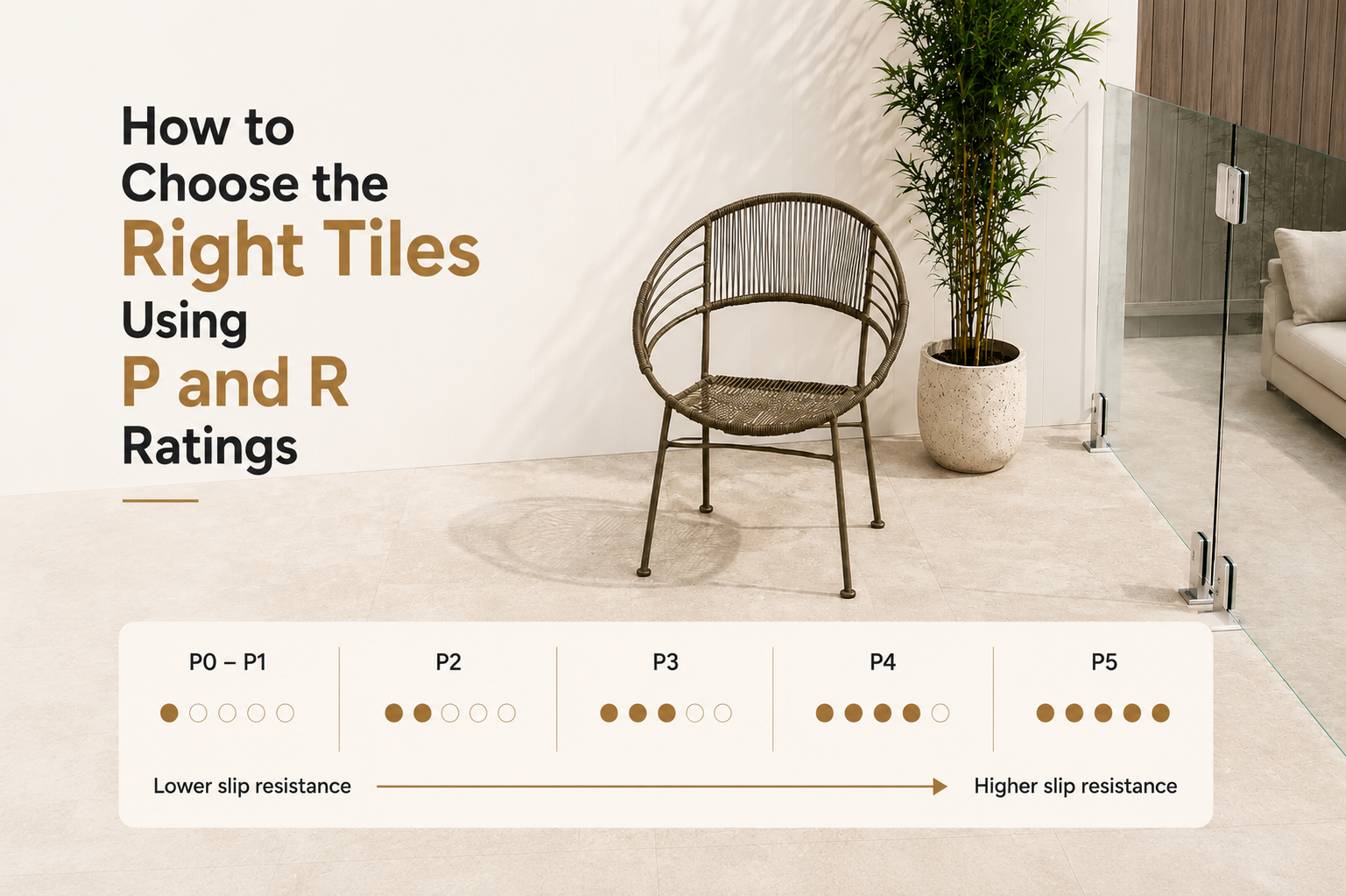
A P rating measures how slip-resistant a tile is when wet. It is one of the essential safety considerations, particularly for the outdoor spaces such as patios, walkways, courtyards and garden walkways, crucial for Australian winters when surfaces can get slippery from rain or early morning moisture.
The Australian and British standard rates tiles from P1 to P5, with higher numbers indicating superior grip and lower slip risk.
P Rating Scale Breakdown
| P Rating | Slip Resistance Level | Best Used For |
|---|---|---|
| P1 | Low | Dry indoor areas only (no wet zones) |
| P2 | Minimal | Indoor areas with occasional moisture |
| P3 | Moderate | General outdoor areas, patios, walkways |
| P4 | High | Pool surrounds, wet areas, sloped surfaces |
| P5 | Very High | Commercial kitchens, steep slopes, high-risk zones |
What Is an R Rating? (Slip Resistance Explained)
An R rating (also called R-value) measures how slippery a tile is when wet. It's a critical safety factor, especially for areas like bathrooms, kitchens and entryways.
The European standard rates tiles from R9 to R13 with higher numbers indicating better grip and lower slip risk.
R Rating Scale Breakdown
| R Rating [1, 2, 3] | Friction Level | Slip Resistance | Best Use | Typical Environments (Suitable for) |
|---|---|---|---|---|
| R9 | Low | ~20° incline | Kitchens, dry areas, alfresco | Residential, low moisture |
| R10 | Low-Moderate | ~25° incline | Kitchens, living rooms | Standard household use |
| R11 | Moderate | ~35° incline | Bathrooms, kitchens, patio, entryways | Wet areas, good friction |
| R12 | High | ~40° incline | Bathrooms, pool edges | Very slippery areas |
| R13 | Very High | 45° incline | Commercial kitchens, hospitals | Extreme slip hazard areas |
How is it measured?
The angle of incline at which a weighted cylinder begins sliding on the tile surface when wet. The higher the R rating, the higher the slip resistance. For instance, R9 means basic slip resistance; however, R13 handles slopes over 45 degrees and offers a stronger grip. In R ratings, the angle tells you about the level of grip a tile provides; higher angles indicate better slip resistance.
Quick Recap of the Difference Between R and P Rating
| Feature | R Rating | P Rating |
|---|---|---|
| How It's Tested | Oil-wet inclined ramp test (testers walk on an oil-coated ramp) | Wet pendulum test (measures the friction of a swinging rubber slider on a wet surface) |
| What It Shows | Grip and safety on sloped surfaces, particularly under oily/greasy conditions | Slip resistance and dynamic friction in wet pedestrian conditions |
| Rating Range | R9–R13 | P0–P5 |
| Used in Australia | Sometimes (typically for specific industrial or commercial applications) | Widely used (the primary standard for compliance and risk assessments) |
How P Ratings Are Tested: The Pendulum Test
P ratings aren't subjective; they're measured using the pendulum test, a standardised method that quantifies slip resistance objectively.
How the pendulum test works:
A rubber slider (simulating a shoe sole) is attached to a swinging pendulum. The pendulum swings across a wet tile surface at a fixed angle and speed. The friction between the rubber and the tile determines how far the pendulum swings before stopping.
- Lower friction = longer swing = slippery tile = lower pendulum test value
- Higher friction = shorter swing = better grip of tile = higher pendulum test value
The test is repeated several times on the same piece of tile at different points to ensure consistency. Results are converted into the P1-P5 scale based on friction coefficient measurements.
Why this matters: This test creates real-time situations such as wet bathroom floors, kitchen spills, poolside surfaces and provides consistent, measurable data that manufacturers can verify. It's the gold standard for slip resistance testing across Australia and is increasingly adopted worldwide.
TABLE- Pendulum test
| Location | Wet Pendulum Test | Oil-wet Inclining Platform Test |
|---|---|---|
| External Pavements & Ramps | ||
| External ramps including sloping driveways, footpaths etc. steeper than 1 in 14 | P5 | R12 |
| External ramps including sloping driveways, footpaths etc. under 1:14, external sales areas (e.g. markets), external carpark areas, external colonnades, walkways, pedestrian crossings, balconies, verandas, carports, driveways, courtyards and roof decks | P4 | R11 |
| Undercover carparks | P3 | R10 |
| Hotels, Offices, Public Buildings, Schools and Kindergartens | ||
| Entries and access areas including hotels, offices, public buildings, schools, kindergartens, common areas of public buildings, internal lift lobbies Wet area | P3 | R10 |
| Transitional area | P2 | R9 |
| Dry area | P1 (see Note 3) | R9 |
| Toilet facilities in offices, hotels and shopping centres | P3 | R10 |
| Hotel apartment bathrooms, en suites and toilets | P2 | A |
| Hotel apartment kitchens and laundries | P2 | R9 |
| Supermarkets and Shopping Centres | ||
| Fast food outlets, buffet food servery areas, food courts and fast food dining areas in shopping centres | P3 | R10 |
| Shop and supermarket fresh fruit and vegetable areas | P3 | R10 |
| Shop entry areas with external entrances | P3 | R10 |
| Supermarket aisles (except fresh food areas) | P1 (see Note 3) | R9 |
| Other separate shops inside shopping centres – wet | P3 | R10 |
| Other separate shops inside shopping centres – dry | P1 (see Note 3) | R9 |
| Loading Docks, Commercial Kitchens, Cold Stores, Serving Areas | ||
| Loading docks under cover and commercial kitchens | P5 | R12 |
| Serving areas behind bars in public hotels and clubs, cold stores and freezers | P4 | R11 |
| Swimming Pools and Sporting Facilities | ||
| Swimming pool ramps and stairs leading to water | P5 | C |
| Swimming pool ramps and stairs leading to water | P4 | B |
| Communal changing rooms | P3 | A |
| Undercover concourse areas of sports stadiums P3 R10 | P3 | R10 |
| Hospitals and Aged Care Facilities | ||
| Bathrooms and en suites in hospitals and aged care facilities | P3 | B |
| Wards and corridors in hospital and aged care facilities | P2 | R9 |
E-E-A-T: Why This Matters for Your Home
Experience: Homeowners who choose the wrong tiles often regret their decision later when the tiles start to show the signs of wear and tear or become slippery.
Expertise: Tile manufacturers have engineered these rating systems after decades of testing. Following them isn't just another marketing tactic; it's the result of rigorous standards designed to help you choose correctly.
Authority: Major tile manufacturers use these same P and R rating systems in their product specifications.
Trust: Checking these ratings before making a purchase is the best way to ensure you're buying tiles suited to your home's actual traffic patterns and safety needs.
Closing Thoughts
Choosing tiles should go beyond colour, pattern and finish. Understanding P and R ratings helps ensure your tiles are suitable for different spaces while providing the durability and safety needed.
P & R ratings help you assess slip resistance according to the Australian Standards. Together, they provide a proper understanding of tiles that gives you confidence to purchase the right tile.
By keeping in mind the right ratings for the right spaces, you can create an environment that not only look great on day one but continue to perform well for years to come.
FAQ’s
Q.1 Which is more important, P or R rating?
Ans. Both are important. While P Rating and R Rating both assess slip resistance, they use different testing methods. The right rating depends on the application's use, exposure to moisture and the level of slip resistance.
Q.2 Is P3 suitable for residential floors?
Ans. Yes. P3 is generally suitable for residential areas such as bedrooms, living rooms and other indoor spaces with low to moderate foot traffic. However, the right P rating depends on the specific area, its exposure to moisture and how much grip is needed for the safe use.
Q.3 What R rating should outdoor tiles have?
Ans. Most outdoor residential applications benefit from an R11 rating or higher to improve grip and safety.